
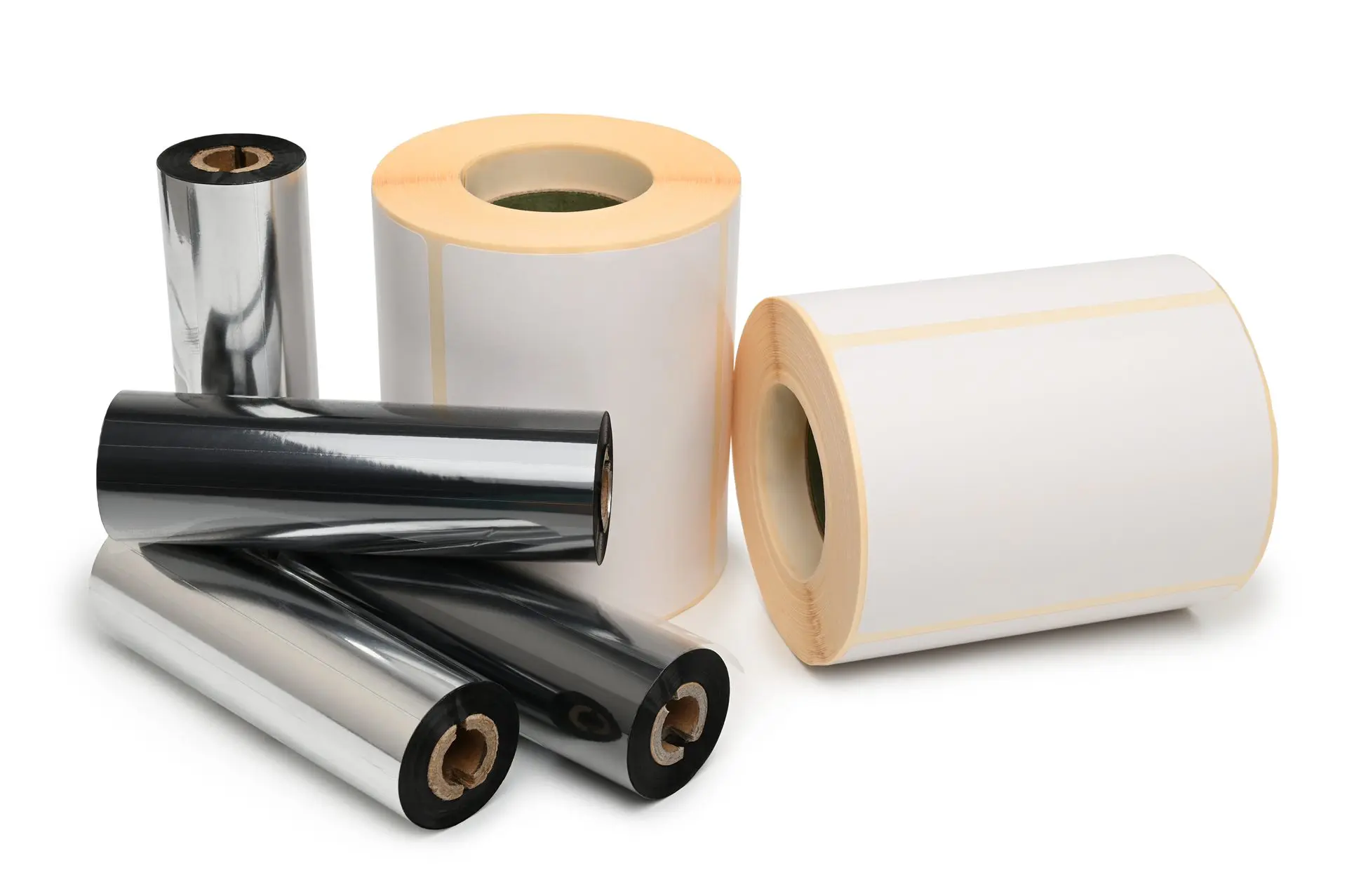
Choosing between direct thermal and thermal transfer labels is not about deciding which technology is better. It is about how long the identification needs to work, what it must survive and how it will be used.
If a direct thermal label already performs reliably through picking, storage and dispatch, there may be no reason to add complexity. If the same label must remain readable for years, withstand abrasion or support long-term traceability, thermal transfer may be the better starting point.
How direct thermal labels work
Direct thermal labels use heat-sensitive material to create the printed image. They do not require a ribbon, which means one less consumable to purchase, change and manage.
This makes them well suited to many short-life applications, including courier labels, dispatch labels, temporary inventory identification and pallet labels that only need to remain readable through a defined movement or delivery cycle.
Direct thermal materials are not all the same. Coatings and constructions vary, so a material selected for an ordinary dispatch label may perform differently from one designed for more demanding handling.
Where direct thermal can struggle
The printed image can be affected by heat, sunlight, abrasion and some chemicals. Depending on the material and environment, it may fade, darken or become difficult to scan.
That does not make direct thermal unsuitable. It means the expected service life and exposure need to be understood before the label is specified.
How thermal transfer labels work
Thermal transfer printing uses a ribbon to transfer the image onto the label material. It is commonly chosen when information must remain readable for longer periods or survive repeated handling, moisture, abrasion, cleaning or demanding industrial conditions.
Typical applications include warehouse racking, asset identification, industrial product labels, durable inventory labels and long-term traceability.
The ribbon and label material must work together
A durable synthetic facestock does not automatically produce a durable printed image. If the ribbon is not compatible with the material, the barcode or text may rub off before the label itself fails.
Wax, wax-resin and resin ribbons provide different levels of resistance. The right combination depends on the facestock, printer, print speed and conditions the finished label will encounter.
Your existing printer matters
Some label printers support both printing methods, while others are direct thermal only. Before changing materials or methods, it helps to confirm:
- the printer model and print resolution;
- the label size and format;
- current print speed and operating environment;
- whether rolls or fanfold labels are used;
- the required barcode quality; and
- how long the information must remain readable.
A sample that looks good at low speed in an office still needs to perform reliably in the production or warehouse environment where it will be used.
One operation may need both technologies
There is no reason to force every application onto the same print method. A business may use direct thermal labels for high-volume dispatch and temporary pallet identification while using thermal transfer for permanent racking, reusable assets or labels exposed to harsher conditions.
This can be the most economical approach: use the simplest suitable construction for short-life requirements and add durability where the application genuinely needs it.
Managing variable data reliably
Whether labels are printed by direct thermal or thermal transfer, their variable data must remain accurate and scannable. Saito Labels & Tags can manage variable data for product, batch, serial, location and logistics labels, including consistent barcode and human-readable formats.
The print method, label construction and data should be considered together. A technically correct barcode is not useful if the image fades, the label detaches or the data is applied to the wrong item.
Start with the job the label must do
Before choosing between direct thermal and thermal transfer labels, answer three questions:
- How long must the label remain readable?
- What conditions will it encounter?
- What printer and scanning equipment will be used?
The right solution is not necessarily the most durable or the cheapest. It is the combination that meets the real requirement without adding unnecessary cost or work.